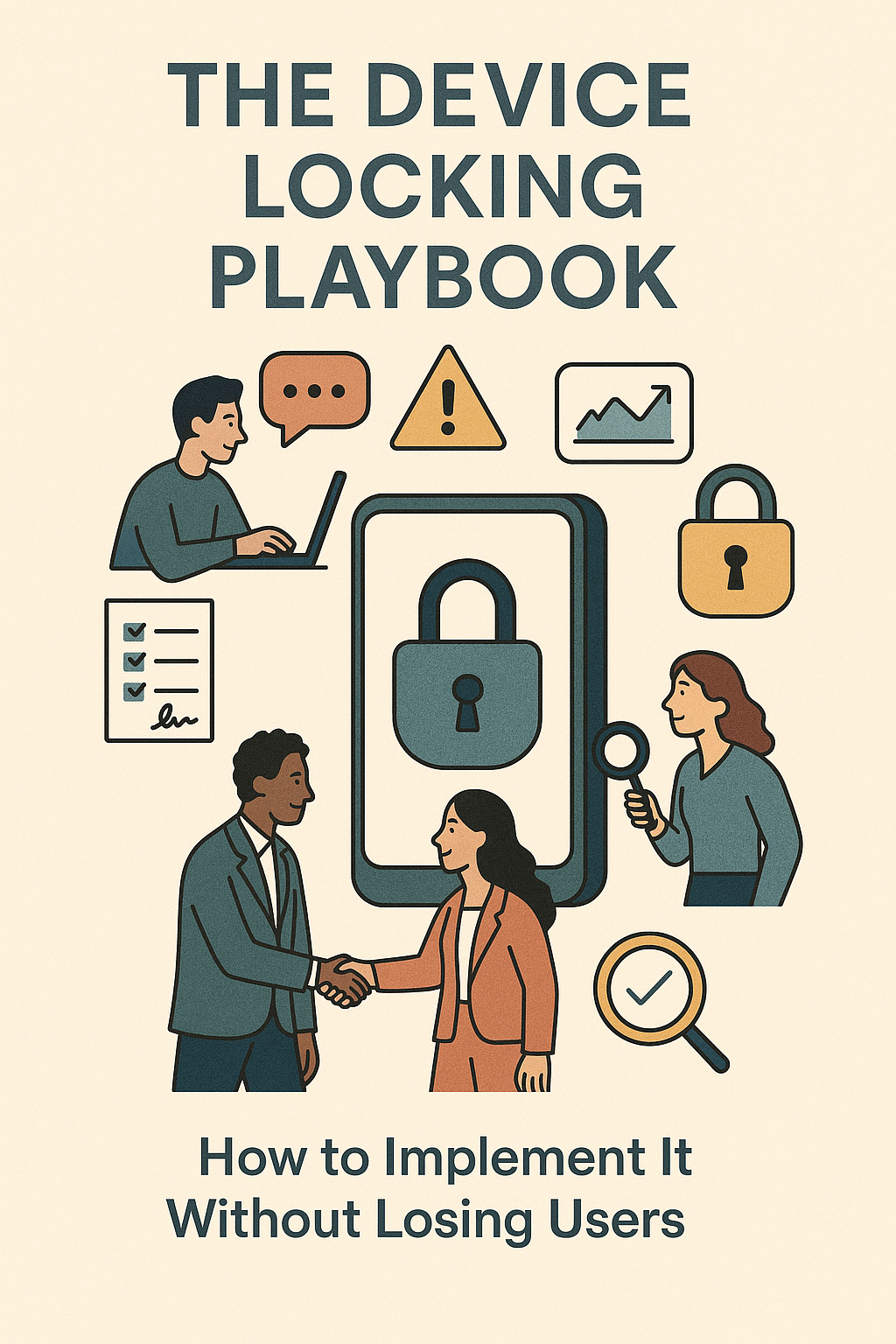
Device locking is becoming one of the most effective repayment enforcement tools in mobile credit and digital lending—doubling recovery rates in some emerging markets. But as Victor Kirnarskiy, CEO of GetMobi, warns: “Turning the device into a locked state is not the goal. The goal is repayment—not punishment.”
This playbook distills Victor’s field-tested insights and global benchmarks. It’s designed for fintech operators, telcos, and lenders who want to implement device locking in ways that strengthen repayment rates while maintaining customer trust, regulatory compliance, and financial inclusion.
Read the full interview with Victor here: https://getmobitech.substack.com/p/device-lock-in-smartphone-financing
Stage 1 – Consent: Set the Ground Rules Early
Why it matters: Without informed consent, device locking can feel like betrayal rather than enforcement. Consent is the foundation of a transparent digital lending UX.
How to do it right:
- Integrate lock terms into the initial financing agreement, clearly visible—not buried in fine print.
- Use plain language and avoid jargon when explaining how and when locks will be applied.
- Incorporate visual simulations during onboarding (e.g., a mock lock screen) so users understand what will happen.
- Provide a simple FAQ covering triggers, escalation, and unlocking.
What to avoid:
- Vague terms like “device may be restricted” without specifics.
- Skipping the consent step for repeat customers.
Stage 2 – Communication: Keep the Channel Open
Why it matters: Even the clearest contract fails if customers aren’t reminded along the way. Continuous communication reinforces repayment discipline and prevents disputes.
How to do it right:
- Use multi-channel messaging—SMS, app notifications, WhatsApp, automated calls.
- Send payment reminders with due dates and outstanding amounts.
- Provide grace period alerts before initiating a lock.
- Keep the tone professional—firm but not fear-based.
What to avoid:
- Only informing the customer after the device is locked.
- Sending internet-only messages when connectivity may already be restricted.
Stage 3 – Escalation: Enforce Proportionately
Why it matters: An immediate hard lock can destroy goodwill and push users toward default. A tiered enforcement model protects both repayment and customer relationships.
How to do it right:
- Apply a graduated lock system:
Soft Lock: Restrict apps; keep calls, SMS, and payment active.
Partial Lock: Limit most functions but allow emergency calls.
Hard Lock: Last-resort full restriction.
- Clearly communicate each stage.
- Offer self-service repayment options before escalation.
What to avoid:
- Treating first-time late payers the same as chronic defaulters.
- Jumping directly to hard lock.
Stage 4 – Unlock Protocol: Minimize Friction
Why it matters: Once a customer pays, delays in unlocking damage trust and reputation. Unlocking defines the end-to-end UX of device locking.
How to do it right:
- Automate unlocks within minutes of payment confirmation.
- Provide 24/7 customer support for disputes and errors.
- Include a manual override for emergencies (e.g., medical needs).
- Confirm via SMS or notification when the device is unlocked.
What to avoid:
- Requiring paperwork after payment.
- Long wait times that fuel customer complaints and churn.
Stage 5 – Monitoring & Feedback: Keep Improving
Why it matters: Device locking is not “set and forget.” Regulations, markets, and user behaviors evolve.
How to do it right:
- Track repayment vs. churn rates post-lock.
- Collect user feedback, especially from those who experienced locks.
- Monitor regulatory frameworks in fintech and telecom.
- Test alternative enforcement models to reduce reliance on hard locks.
What to avoid:
- Assuming repayment = satisfaction.
- Ignoring compliance or documentation for audits.
Checklist for Responsible Device Locking
Secure informed consent at onboarding.
Communicate repayment reminders across channels.
Escalate proportionately—avoid blunt force.
Unlock instantly after resolution.
Monitor results, stay compliant, and adapt.
Bottom line: Device locking is not a punishment—it’s a fintech tool for financial inclusion when applied responsibly. The leaders in mobile credit and telco-fintech partnerships will be those who embed empathy, clarity, and fairness at every stage of the digital lending lifecycle.
Full interview with Victor Kirnarskiy: https://getmobitech.substack.com/p/device-lock-in-smartphone-financing